Building redundancy into your DDI server architecture is critical to ensure your DDI services are highly available. How much redundancy is a question of risk, the business impact of any failure and available budget.
The DNSBOX range is designed and priced such that, for a given budget, you can build more redundancy into your architecture.
DNSBOX gives you redundancy in layers:
- It makes the DNS master-slave approach easy and affordable
- Its CFast architecture gives you an extra layer of redundancy for free.
- You can add extra servers for redundancy to your architecture, without adding high cost.
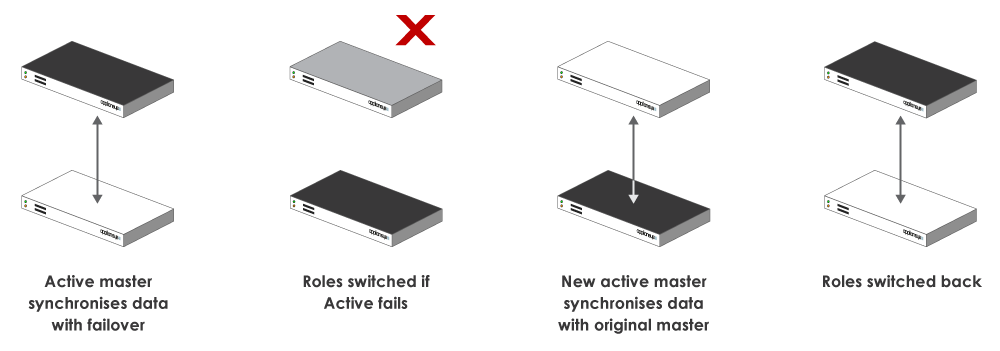
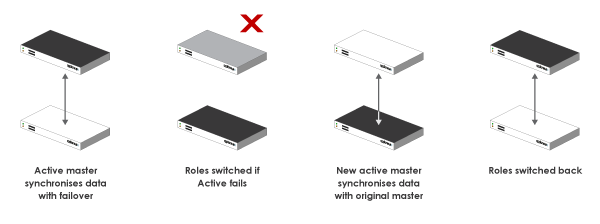
For added redundancy, DNSBOX masters can be deployed with a failover unit. This is deployed in a standby mode and configured to synchronise data from the active master. In the event of the active server failing, the failover is restarted in active mode and starts to respond to zone transfer requests and name queries.
When the original active machine becomes available again, it is placed in standby mode until the data has been fully synchronised back. Both machines are then restarted and their modes reversed.
Unlike other vendors, ApplianSys prices failover units significantly cheaper than the first master unit.
In some scenarios, the normal DNS approach to redundancy, designed into BIND, won’t deliver the performance you need. So a single IP address must deliver 100% uptime. This demands high availability and rapid cutover in the event of a DNS server becoming unavailable.
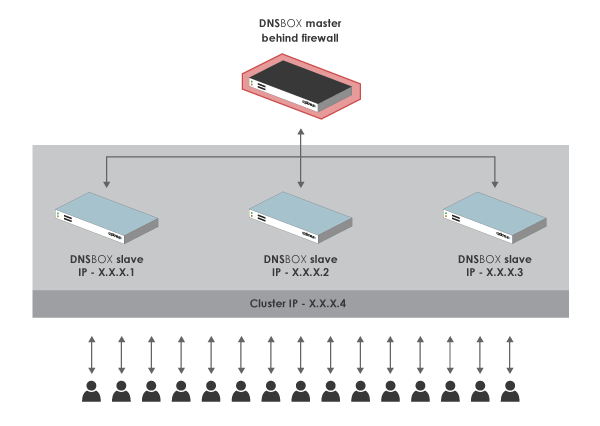
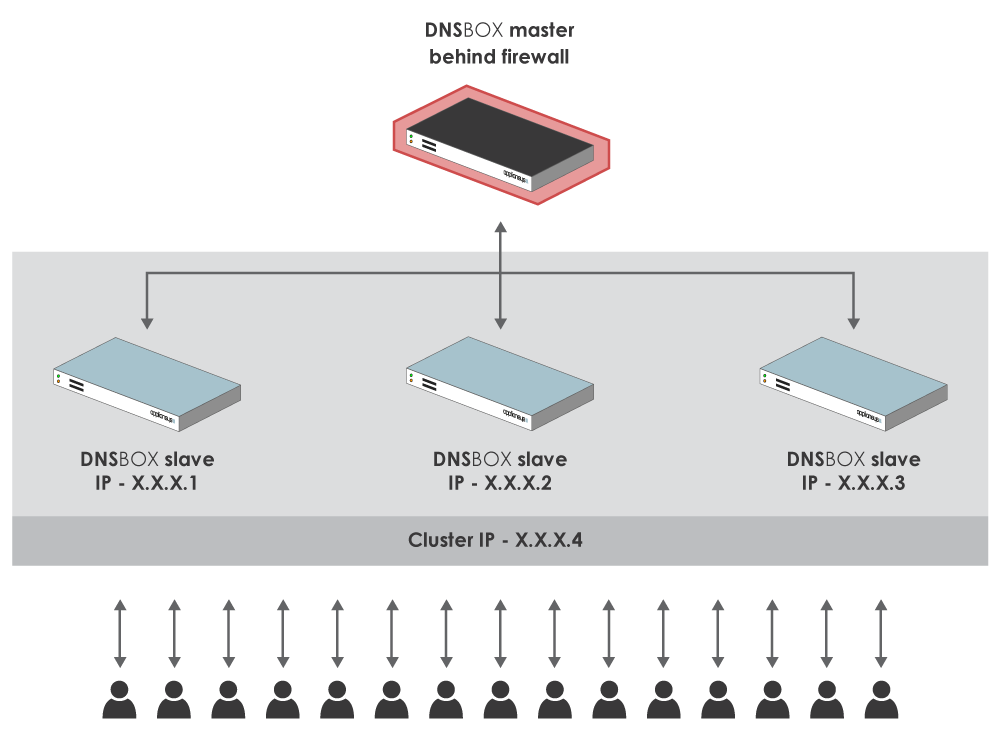
DNSBOX achieves this by clustering two or more slaves. This combines failover and load-balancing functionality to give you a highly available, high performance DNS caching service. Unlike the standard approach, a DNSBOX cluster has a single IP address, so client configuration is simplified.
DNSBOX supports peer-to-peer and hub-and-spoke DHCP failover, giving network teams flexible options for local, distributed and mixed network designs.
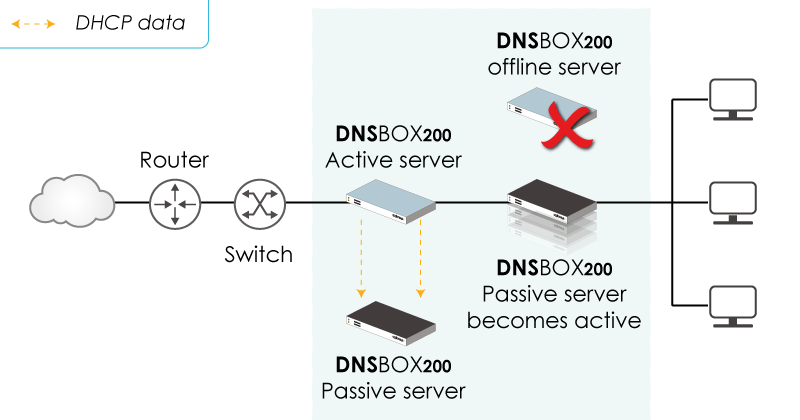
In peer-to-peer deployments, two appliances are paired one-to-one. Both hold a full, independent copy of the DHCP database and can serve clients if the other becomes unavailable.
Peer-to-peer failover can run in Active/Passive mode, with a passive server on standby, ready to take over if the active server fails.
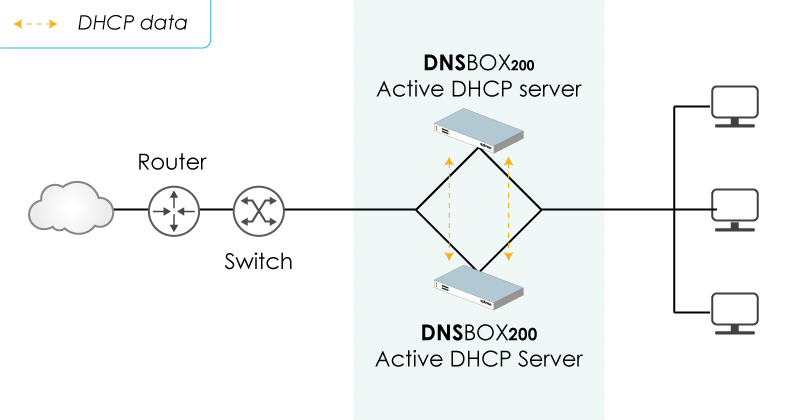
Whilst in Active/Active mode both servers process DHCP traffic with one serving all clients if the other active server fails.
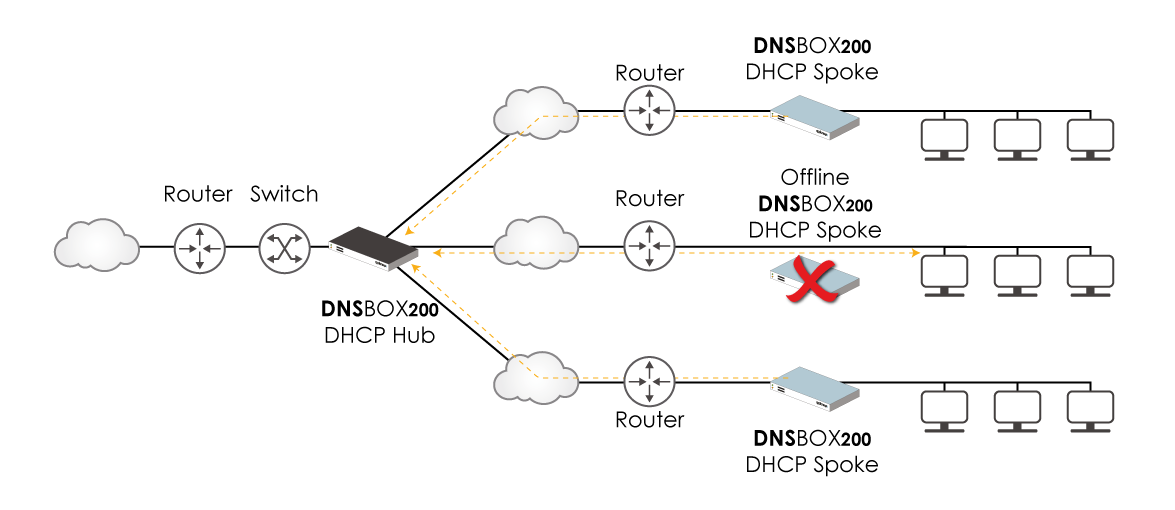
In Hub-and-Spoke deployments, each spoke serves DHCP locally for its own subnets, while a central hub holds synchronised configuration and lease state and can take over if a spoke becomes unreachable.
The DNSBOX authoritative slave has a useful redundancy feature engineered by ApplianSys.
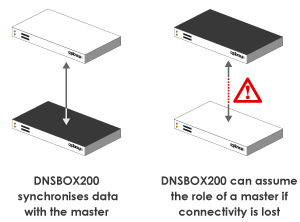 Normal BIND behaviour is that when a slave zone expires, if the master is for some reason unavailable, the zone will no longer be served to clients.
Offline master mode avoids this problem:
- DNSBOX takes zone backups regularly
- If connectivity with the master is lost, you can enable Offline Master Mode
- DNSBOX then assumes the role of a master, continuing to serve the zones from their last known ‘good’ state
This offline feature is also useful in planned instances of master-slave disconnection, such as during migration or before upgrades.